
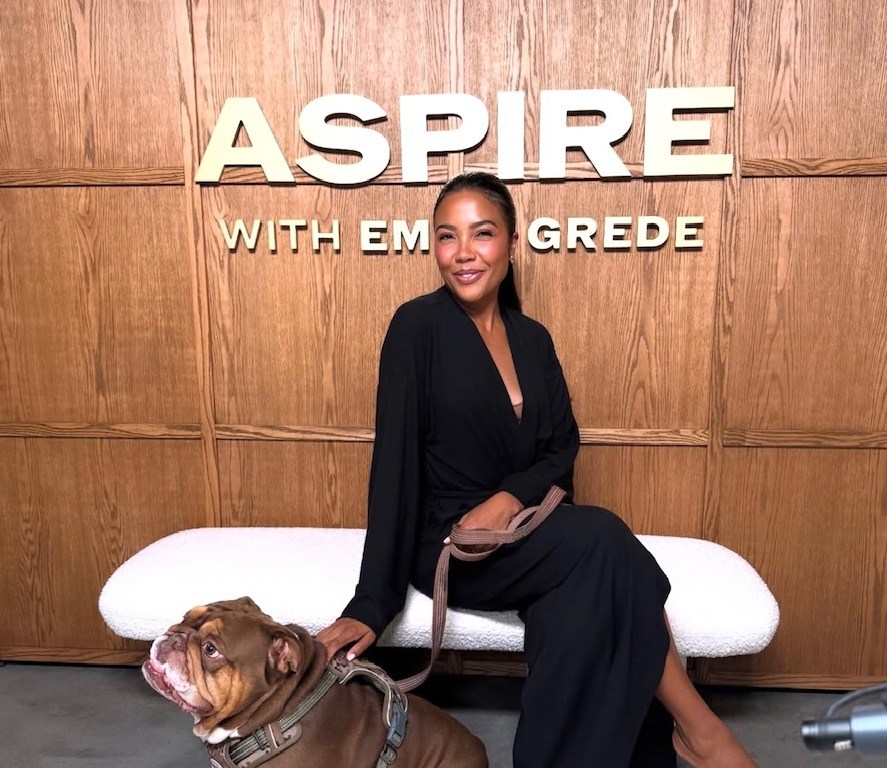

Podcasts have become our modern salons; a place where ambitious minds gather, not in smoky Parisian cafés or boardrooms, but through headphones on commutes, gym runs, and quiet evenings at home. Yet in a saturated landscape of fast takes and bite-sized episodes, two shows stand apart for their ability to inform, inspire, and transform how we think about business, ambition, and the very architecture of success: Acquired, hosted by David Rosenthal and Ben Gilbert, and Aspire with Emma Grede.
They are wildly different in form: one a marathon of corporate history and strategic insight, the other an intimate conversation between an entrepreneur and her guests yet both offer something rare: depth, humanity, and frameworks that endure.
Acquired: Where Business Becomes Epic Storytelling

David Rosenthal and Ben Gilbert have become unlikely griots of corporate history. Their podcast, Acquired, doesn’t skim the surface of companies like Amazon or Apple in tidy soundbites. Instead, they go long. Really long.
The most famous examples? A four-hour episode on Hermès and a three-hour deep dive into LVMH episodes that, rather than daunt, mesmerise listeners. Here is business not as spreadsheet or press release but as Shakespearean narrative: dynastic families, power struggles, philosophical paradoxes, and strategies that hinge on identity as much as economics.
The Hermès Episode: The Discipline of Scarcity
At just over four hours, the Hermès episode is not a podcast; it’s an experience. Rosenthal and Gilbert take us from the brand’s humble 1837 beginnings – a saddle and harness workshop in Paris through its transformation into one of the most iconic luxury houses on earth.
What captivates is not simply the family saga or the famous Birkin bag, but the counterintuitive philosophy that has defined Hermès for six generations: say no more often than you say yes. While competitors embraced mass marketing, Hermès resisted. While others chased volume, Hermès cultivated scarcity. While conglomerates scaled, Hermès doubled down on the artisanal, the intimate, the almost eccentric.
The episode crescendos with the family’s legendary stand against Bernard Arnault and LVMH’s takeover attempt, a moment that reads like a corporate thriller, but one with profound strategic implications. Hermès chose defiance over dilution. And it worked.
For any entrepreneur or student of business, this episode is a blueprint: proof that strength can be found not in expansion, but in discipline; not in scale, but in identity.
The LVMH Episode: Scale as an Art Form

If Hermès embodies scarcity, LVMH represents scale perfected.
The three-hour-plus LVMH episode explores Bernard Arnault’s rise how he transformed a modest stake in a struggling textile company into the world’s largest luxury conglomerate, spanning Louis Vuitton, Dior, Sephora, Tiffany, and more. If Hermès is the boutique jeweler, LVMH is the grand architect of a cathedral of luxury.
Arnault’s genius, as the hosts explain, lies in the aggregation of maisons: preserving brand independence while giving them the distribution, financial firepower, and global reach of a giant. The result is a paradox: conglomeration without homogenization.
Listening to these two episodes side by side is revelatory. Hermès and LVMH represent opposite philosophies of luxury, both wildly successful. Together, they provide not just a history of fashion but a treatise on strategy itself teaching us that ambition can take many shapes, and survival often depends on clarity of purpose.
And here lies the brilliance of Acquired: these are not dry business case studies. They are epics. They demand time and attention, but reward it tenfold, leaving listeners not only smarter but more curious, more nuanced in their understanding of how power and culture intersect in business.
Aspire with Emma Grede: Conversations That Redefine Ambition
Where Acquired gives us scale and sweep, Aspire with Emma Grede offers intimacy and immediacy. Emma Grede, co-founder of Good American and founding partner of SKIMS, knows what it means to build, hustle, and navigate the complexities of being a woman and a woman of colour in business. Her podcast is not a lecture but a salon of another kind: an intimate table where listeners join her and her guests as they strip ambition down to its raw components.
Two episodes in particular stand out:
Mellody Hobson: Redefining Power in Finance
The conversation with Mellody Hobson, co-CEO of Ariel Investments and one of the most influential women in global finance, is nothing short of masterful.
Hobson recounts growing up on the South Side of Chicago, raised by a single mother, and how those early experiences shaped her relationship with money. She shares how she rose through the ranks of Ariel Investments, eventually becoming president in under a decade, a trajectory as rare as it is instructive.
What makes the episode unforgettable is Hobson’s candor. She speaks about being the only Black woman in countless boardrooms, about the internalized fear of inadequacy, and about the advice that changed her life: be unapologetic about your power.
This is not just a story of triumph; it is a playbook on authority, resilience, and the emotional intelligence required to lead in spaces not designed for you. For any woman and indeed, any listener the episode is both a mirror and a map.
Diarrha N’Diaye: The Courage of Failure
Another episode every entrepreneur should queue up is Grede’s conversation with Diarrha N’Diaye, founder of beauty brand Ami Colé.
Unlike most founder stories, this one does not climax with an acquisition or IPO. Instead, N’Diaye speaks candidly about launching Ami Colé with vision and passion, finding early success and then facing the devastating decision to shut it down.
What unfolds is a rare and radical honesty about failure: the shame, the grief, the lessons, and the eventual reframing of what it means to be a founder. N’Diaye describes failure not as an ending but as a form of tuition expensive, painful, but invaluable.
Emma handles the conversation with empathy but also rigor, ensuring that listeners walk away not with pity but with perspective. The episode becomes a manifesto: failure is not the opposite of success; it is part of its architecture.
Discover more from Chaud: The Magazine
Subscribe to get the latest posts sent to your email.
 Chaud: The Magazine